
Meito Corporation Achieves Japan’s First Sea Small-Parcel Customs Clearance under New Simplified Maritime Regime (Company Research)
Meito Corporation Achieves Japan’s First Sea Small-Parcel Customs Clearance
under New Simplified Maritime Regime (Company Research)
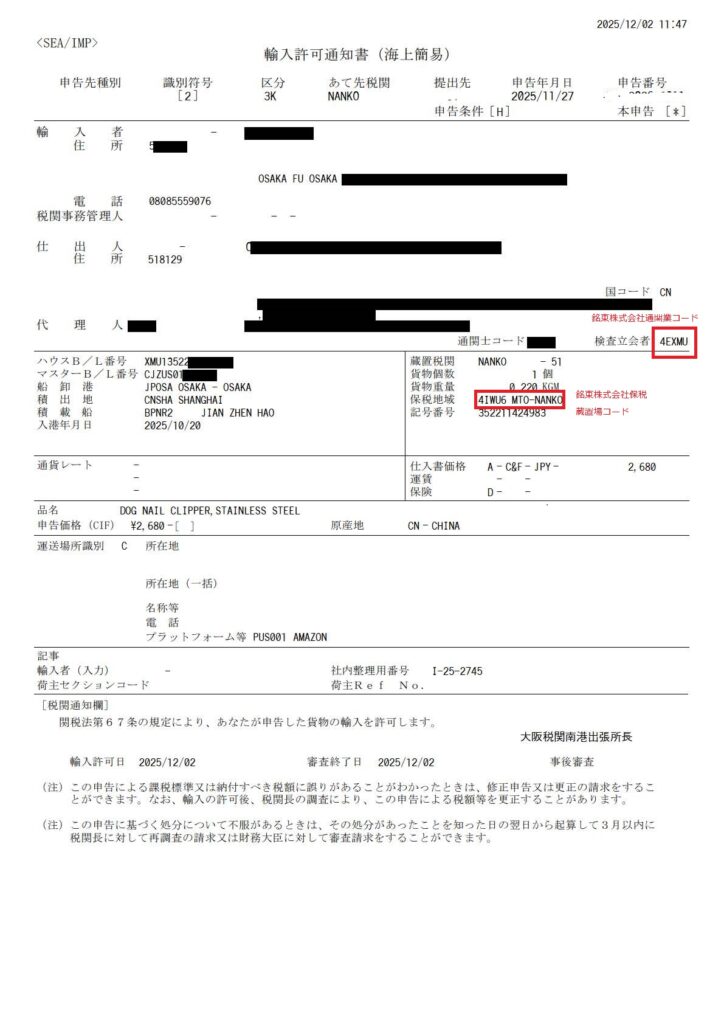
Meito Corporation (Head Office: Osaka, Japan; President & CEO: SHO RYU, hereinafter “Meito”) is pleased to announce that, under Japan’s new simplified customs clearance regime for sea small-parcel cargo and the 7th generation of the NACCS electronic customs system, we successfully obtained an import permit on December 2, 2025 for a shipment of sea small-parcel cargo arriving at Osaka Port (hereinafter “sea small parcels”).
Based on our own research of public information and interviews with industry stakeholders, we believe that this case represents one of the very first successful applications of the new regime in Japan, and the first successful sea manifest import customs clearance case nationwide as of 11:00 a.m. on December 2, 2025 (company research).
If you are aware of earlier practical cases under the same regime, we would appreciate it if you could kindly contact us.
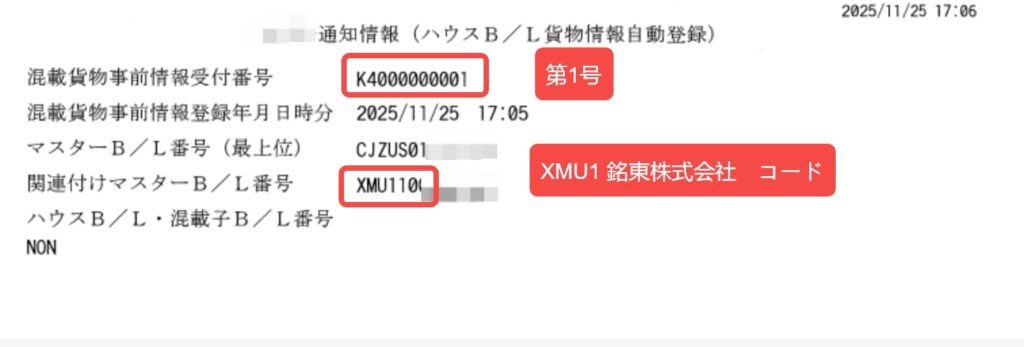
After the new regime came into force on October 12, 2025, a certain lead time was required before the first import permit could be granted. This was due to necessary internal procedures within Osaka Customs—such as adding new categories for e-commerce cargo stored in bonded warehouses—as well as registrations, filings and other administrative processes related to our bonded facility. These steps ensured that a proper and compliant operational framework was fully established before live operations commenced.
1. Background: New simplified regime for sea small parcels and the October 2025 reform
In recent years, cross-border e-commerce (EC) has grown rapidly, leading to a surge in small-lot import cargo, including parcels for online shopping and goods handled via fulfillment services. At the same time, authorities have been facing challenges such as under-declaration, misuse of platform names, and the inflow of illegal drugs and IP-infringing goods. Strengthening border controls while maintaining fair taxation has become a critical policy priority.
Against this backdrop, on October 12, 2025, Japan’s Ministry of Finance and Japan Customs launched the 7th generation of NACCS, introducing a simplified import customs regime specifically for sea small-parcel cargo. On the same date, new import declaration items were added for all imports, such as:
-
Delivery destination (name and address), and
-
Whether or not the shipment is “online-shopping (EC) cargo”;
and, where applicable, the name of the EC platform and other related information.
This reform created a legal and system framework that allows large volumes of small-lot cross-border EC cargo to be handled efficiently via maritime transport, which had traditionally lagged behind air freight in the small-parcel segment.
2. First successful clearance case: TEMU & Amazon parcels arriving on the “Ganjin” ferry
As a licensed customs broker and bonded warehouse operator, Meito has long been handling large volumes of cross-border EC cargo centered around the Osaka Nanko area.
In this first-case project, we acted as the customs broker (declarant) for sea small parcels shipped from Shanghai to Osaka Port on the Japan–China international ferry “Ganjin”. The cargo consisted of cross-border EC orders from TEMU, Amazon and other platforms. Under the new regime, Meito handled the entire process end-to-end—from customs declaration and import permit acquisition to storage and sortation at our bonded warehouse.
Under the new system, it is essential to accurately link detailed shipment information with EC platform data in advance, and to perform simplified declarations for tariff classification and tax rates. Leveraging our in-house data cleansing capabilities and NACCS integration, Meito can process the large and complex datasets characteristic of sea small-parcel cargo in a short time, enabling smooth import permit issuance (dated December 2, 2025).
Meito is also one of the very few customs brokers in Japan that operates its own X-ray inspection machines on site for cross-border EC cargo. By cross-checking cargo and order data with X-ray images, we have built a risk-based screening system that can proactively flag high-risk shipments. This enhances our ability to detect suspicious items such as illegal drugs, IP-infringing goods and hazardous materials. Working in close cooperation with Osaka Customs and other authorities, we contribute to preventing illegal imports, maintaining fair trade and ensuring public safety.
In addition, drawing on our extensive experience in EC logistics, we have introduced a fully automated sortation conveyor line and automatic measuring devices for weight and three-dimensional size. These systems are linked with customs status and delivery conditions, enabling high-precision automated sortation. As a result, even for sea small parcels, we can maintain service levels and lead times comparable to air small-parcel operations, while handling large volumes efficiently.
3. Two years of system development backed by the President’s research
Ever since the new regime for sea small parcels was announced, Meito has spent roughly two years designing, developing and testing the necessary systems. This work builds on a series of R&D initiatives led by our President & CEO, RYU SHO
, in the field of “Customs × IT”.
, in the field of “Customs × IT”.
(1) 2019 – “Air Cargo Customs Support System”
We developed an in-house system to:
-
cleanse MAWB/HAWB-level declaration data for international air cargo,
-
generate NACCS-ready data and perform bulk import,
-
automate billing, and
-
simulate optimal freight rates.
Whereas it previously took one customs specialist and three clerks about four hours to process 1,000 HAWBs, the new system allows one customs specialist and one clerk to complete the same volume in roughly one hour, making it feasible to handle large volumes of cross-border EC cargo.
(2) 2021 – “Automated Notification System for Customs Permits and Tax Amounts”
In response to the fact that NACCS outputs customs permits only as PDFs with no API interface, we built a system that:
-
automatically parses export/import permit PDFs,
-
extracts key data such as declaration numbers, importer/exporter information and duty/VAT amounts,
-
stores the data in a database, and
-
sends real-time notifications to stakeholders via Webhook.
This significantly reduced manual workload for small and mid-size importers and customs brokers, and eased the financial burden of temporary tax advances by brokers.
(3) 2023 – “Bonded-Site Support System for Non-API NACCS Notifications”
For bonded warehouse operators, NACCS had traditionally printed out permits, OLT (bonded transport) notices and inspection notices automatically on paper. We developed a system that:
-
automatically reads these printed notification PDFs,
-
converts them into structured data, and
-
distributes them in real time to on-site devices via Webhook.
By eliminating manual checking and transcription from paper, the system has dramatically improved information flow and process control in bonded facilities and has been highly rated by on-site staff.
(4) November 2025 – Academic presentation at the Global Business Society
On November 30, 2025, at the Global Business Society 2025 Annual Conference held in hybrid format at Osaka University (Toyonaka Campus), a paper titled:
“A Supply Chain Network Equilibrium Analysis on the Efficiency of Cross-border EC Considering Purchasing Agent Process”
was presented in the general business session by lead author Rikuto Nakaji (Kyoto University), with our President RYU SHO
—a Research Fellow at Kyoto University Graduate School of Engineering (Transportation and Information Engineering)—as the second author.
—a Research Fellow at Kyoto University Graduate School of Engineering (Transportation and Information Engineering)—as the second author.
The paper explicitly models the purchasing-agent process in cross-border EC, and uses supply chain network equilibrium theory to analyze optimal logistics network structures in light of cost, lead time and demand distribution.
RYU SHO
contributed practical expertise in cross-border EC operations, customs clearance, bonded warehouse management and system design.
Our new sea small-parcel clearance system incorporates not only the system development achievements in (1)–(3), but also the supply chain network insights from this academic work. It is therefore designed with a broader perspective of optimizing the entire cross-border EC supply chain, including mode choice (air vs. sea) and route selection. Thanks to the President’s dual role in academic research at Kyoto University and hands-on customs and bonded operations, we were able to build a production-ready system from the very start of the new regime.
4. Key benefits for cross-border EC platforms and sellers
The new system and operation offer the following advantages to overseas partners, including platforms and merchants in North America, Europe, Korea and other Asian markets:
-
Stable, compliant access to Japan’s new simplified regime for sea small-parcel imports
-
End-to-end integration of customs clearance, bonded storage, automated sortation and last-mile handover
-
Cost-effective maritime transport options to complement air express, with competitive lead times
-
Enhanced compliance and risk management through in-house X-ray screening and data-driven risk scoring
-
Real-time visibility of customs status and bonded operations via system integration
By leveraging sea transport under the new regime, cross-border EC players can rebalance cost, lead time and service level for Japan-bound shipments.
5. Comment from President & CEO RYU SHO
“In cross-border EC, the real competition is about how quickly, affordably and reliably you can deliver to the end customer.The new simplified regime for sea small-parcel cargo is a turning point for Japanese customs, and a key opportunity to shift part of the small-parcel volume from air to sea.Since our founding, Meito has developed customs operations, IT systems and academic research as one integrated effort. As a research fellow at Kyoto University, I work on transportation and logistics systems and supply chain networks, while at Meito we focus on building IT that is genuinely usable on the ground. We also continue to invest in on-site infrastructure such as in-house X-ray inspection and fully automated sortation lines.This first successful case under the new regime is a milestone that brings all of these efforts together. Going forward, we will continue working closely with Osaka Customs and other authorities to further enhance cross-border EC logistics to and from Japan, using both sea and air.”
6. Future initiatives
Building on the success of this first case, Meito plans to:
-
Propose Japan-bound sea small-parcel solutions to cross-border EC platforms such as TEMU and Amazon, and to their merchants worldwide
-
Design multimodal transport options that combine sea and air to optimize cost, lead time and CO₂ emissions
-
Explore OEM and shared-use models for our systems with small and mid-size customs brokers and importers
-
Further digitalize bonded-site operations and strengthen integration with automatic sortation machinery
-
Advance risk analysis using our in-house X-ray inspection equipment in close cooperation with customs authorities to combat illegal trade
Through our integrated approach of Customs × IT × Bonded Operations × Academic Research, Meito aims to be a key infrastructure partner for Japan-bound cross-border EC, supporting the growth of our customers’ businesses and the healthy development of international trade.
About Meito Corporation
Meito Corporation is a customs broker and international logistics company headquartered in Osaka and Tokyo, Japan. Starting from Japan–China logistics, Meito now operates designated warehouses for platforms such as TEMU and Tmall, and handles cross-border EC cargo inside Japan Post facilities and other strategic locations, supporting a wide range of merchants shipping to Japan.
By combining customs brokerage, bonded warehouse operations, in-house WMS and customs support systems, as well as joint research with universities and continuous investment in X-ray inspection and automated sortation equipment, Meito positions itself as a “development-driven logistics company”. Our goal is to become one of Japan’s leading cross-border EC logistics platforms for partners around the world.RYU SHO